
For many translators, writing begins as an act of listening — a quiet, precise labour of carrying someone else’s voice across the threshold of language and culture. But what happens when the need to speak becomes stronger than the safety of speaking for others? That question has stayed with me for years. And it finds its clearest answer in the lives and works of many feminist authors whose writing is deeply underpinned by translation in its various forms.
Some of these authors are widely celebrated for their literary achievements, yet their work as translators often remains in the shadows. This is true for two Algerian feminist authors who marked my teenage years: Taos Amrouche and Assia Djebar.
My encounter with Djebar’s work was accidental. I was a teenager, stifled by heat, rage, and the confinement of yet another summer indoors during what came to be known as Algeria’s Black Decade. The title and cover image of Femmes d’Alger dans leur appartement mirrored my own confinement during those years. Reading the book was both a shock and a revelation: Djebar’s prose sounded like the language I had grown up with — the oral rhythms of my grandmother, the songs, and stories of Kabyle women, the lulling voice of my mother reading from Taos Amrouche’s collection of Kabyle stories Le grain magique (The Magic Grain) at bedtime. These voices were not born in French, yet they travelled through it, carried across from Kabyle and Arabic into the language of the other. I realised that storytelling in another’s language could itself be a form of resistance — a way of making those voices heard beyond the confines of their own linguistic world. It awakened in me the desire to become a translator, to embrace the languages of others as bridges rather than barriers.
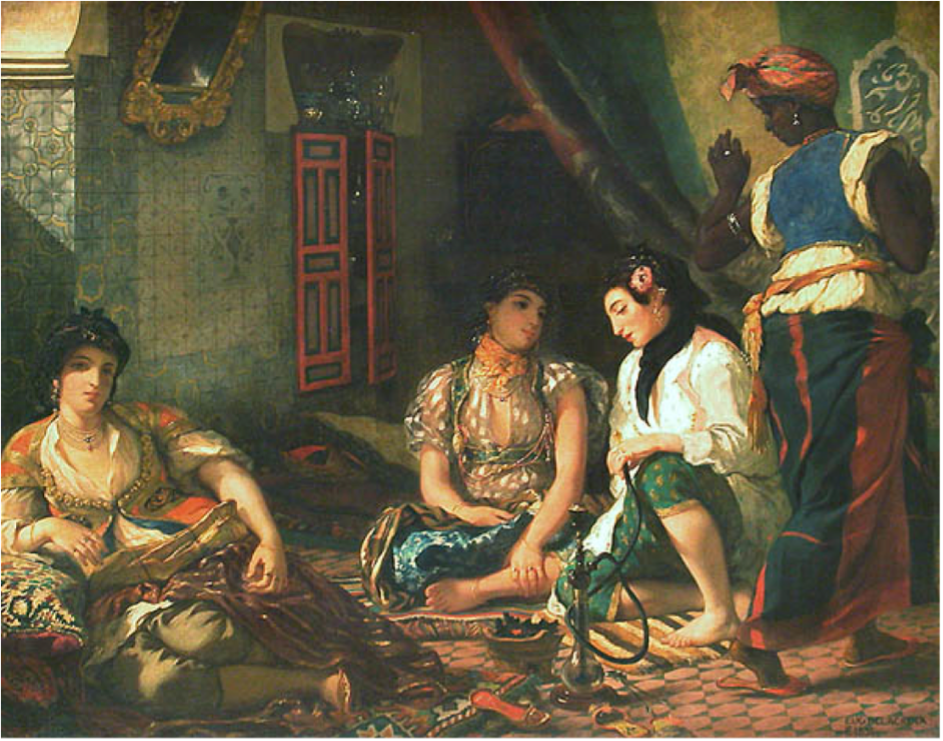
Djebar explains her choice of Delacroix’s 1834 Femmes d’Alger dans leur appartement as the book’s title and cover image. Painted after the French conquest of Algiers, the work depicts three Algerian women in an ornate interior, framed through what would later be called the Orientalist gaze — silent, static, and exoticised. By adopting this title for her 1980 short story collection, Djebar deliberately reclaims and subverts that image, giving voice to women who, in art and history, had been painted and silenced. In her hands, the “apartment” is no longer merely a site of confinement, but a space of memory, testimony, and resistance.
The cover thus becomes a metaphor for her role as an intersemiotic feminist translator: turning oral narratives into written form, interwoven with interlingual translation as her French prose strives to remain close to the rhythms of the Arabic and Berber languages of the women she writes.
This connection between the oral and the written lies at the heart of both Amrouche’s and Djebar’s work. Taos Amrouche’s Le grain magique exemplifies feminist intersemiotic translation. In both cases, feminine orality — traditionally transmitted by women in domestic spaces — is transposed from the ephemeral, performative medium of speech into the fixed form of French writing. This act is doubly transformative: it moves between semiotic systems (orality to writing) and between languages (Kabyle or Algerian Arabic into French), producing what Fatma-Zohra Ferchouli Kouchkar terms a “double translation of the feminine orality.” For Amrouche, as for Djebar, this is not merely a literary gesture but a feminist one: it archives voices silenced by both patriarchal traditions and colonial domination, while allowing the rhythms, imagery, and cadences of the source cultures to permeate the French text.
Taos Amrouche’s role as a feminist translator becomes even more prominent when we consider her subtle, behind-the-scenes work in editing and mediating her mother’s, Fadhma Aït Mansour, autobiography Histoire de ma vie (Story of My Life). Taos acknowledged that the book was entirely her mother’s voice and story, yet she acted as a mediator — a kind of “editor-translator” — transforming her mother’s spoken narrative style into the conventions of written French. In this sense, she was not only preserving a life story but also performing another intersemiotic translation of feminine orality into a textual form that could survive.
Many women writers begin as translators. Kate Briggs, Jhumpa Lahiri, Mireille Gansel, and Leila Aboulela — to name only a few — all began as translators or cultural mediators before stepping fully into authorship, giving in to the itch: the quiet, burning desire to speak on their own voices, and the courage to act on it — a step that requires confronting fear, shame, self-doubt, and often, inherited silence.
Many authors become translators through the act of self-translation. Writers like Umberto Eco, Julian Green, and Samuel Beckett moved fluidly between languages, often translating their own work as part of a broader aesthetic or philosophical project. For them, self-translation could be seen as a matter of style, intellectual play, or creative control. But for many women translators turned authors, the shift is more existential, an act of survival. It is about reclaiming voices that have been marginalised, mistranslated, or silenced altogether.
It is an act that demands courage. That’s why we need to celebrate the women who make that shift — to recognise the courage it takes to claim a voice of their own, especially after years of shaping the voices of others. They translate others until, one day, the silence inside becomes too loud to bear. And then, like Djebar and Taos Amrouche, the inner voice is unleashed. Not because it is safe. But because it is the only way to live truthfully — in their own name, in their own voice.
Khadidja Merakchi, Heriot-Watt University, Edinburgh
Image: Femmes d’Alger dans leur appartement” — the 1834 painting by Eugène Delacroix that gave its title to Assia Djebar’s book.
Source: Louvre