
An exploration of how gender, maternity and translation converge in Gabriela Mistral’s poetry to recover obscured female agency and reframe her work within a feminist interpretive space.
Women’s literary contributions have long been marginalised, their voices silenced or overlooked. The Chilean poet Gabriela Mistral experienced this invisibility both during her life and after her death, striving instead to assert her right to self-representation.
In patriarchal societies, women are often confined to the idealised role of mothers, their identities reduced to maternity as their only fulfilment. More than sixty years after her death, critics still portray Mistral as a maternal icon, perpetuating a traditional view that ignores the ambivalence in her poetry. Yet Mistral reclaims the image of the suffering mother to assert her individuality and subvert patriarchal norms. Behind a mask of conformity, she reshapes the very symbols of femininity to express resistance and self-awareness, turning maternal suffering into a space of agency and voice.
For my master’s thesis, I produced a feminist translation of one poem from each of Mistral’s major collections into Italian. My approach focused on references to the reproductive process—pregnancy, nurturing, education, and socialisation—to enable readers to interpret her work from a feminist perspective.
Translating the feminine voice and the myth of maternity
In Desolación (1922), Mistral intertwines the figures of the mother and the poetess. The sonnet El niño solo (The Lonely Child) depicts a woman drawn by the cries of a hungry baby left alone while his mother works. She nurses the child, and though her identity is uncertain, the act of breastfeeding creates an intimate bond, blurring the line between self and other. Through this encounter, Mistral transforms motherhood into a metaphor for female solidarity and mutual recognition.
Her precise lexical choices reveal this symbolic depth. The woman, inebriated (embriagada) by the baby’s gaze, soothes him by offering her breast. When he sleeps, her breast grows richer (enriquecido), prompting her to sing a lullaby (una canción de cuna subió). The verb subir—linked to the idea of milk rising—establishes a parallel between song and breastfeeding. Milk, transcending biology, embodies the cultural and imaginative dimensions of maternity. Poetry thus mirrors the generative act, elevating creative expression to a feminine form of productivity that transcends biological motherhood.
In my translation, I sought to preserve this feminine voice. To maintain rhyme, I introduced “with her heart shrunk” (con il cuore stretto) to convey the emotional tension of the woman hearing the baby’s cry. Later, the child searches for the “nipple of the rose” (el pezón de la rosa), a metaphor for nourishment and poetic creation. The woman’s song “rises” (le sube), uniting music and motherhood. Since Italian lacks a verb equivalent to subir, I used generare (to generate) to express both poetic and biological creation. In the final stanza, the mother returns home, joyful to find her child calm and resting. To preserve the symbolism of the breast bathed in milk (bañaba mi pecho enriquecido), I translated bañar as impregnare (to impregnate), evoking density and continuity between nourishment and poetry.
Translation as a discursive space for inter- and intra-gender mediation
Mistral’s work redefines motherhood as a creative and symbolic act. By transforming a traditional marker of femininity into a metaphor for artistic authorship, she challenges patriarchal notions of creation and reclaims poetry as a feminine space. Ultimately, Mistral affirms that both motherhood and writing share the same creative impulse—the power to give life, form, and meaning to what was once silent. A feminist translation of her work thus becomes an act of critical re-appropriation, recovering the plurality of women’s voices inscribed in her verse.
Matilde Miraglia
The Franciscan Order of Chile authorises the use of the work of Gabriela Mistral. The equivalent of the author’s rights is granted to the Franciscan Order of Chile, for the children of Montegrande and of Chile, in accordance with the will of Gabriela Mistral.
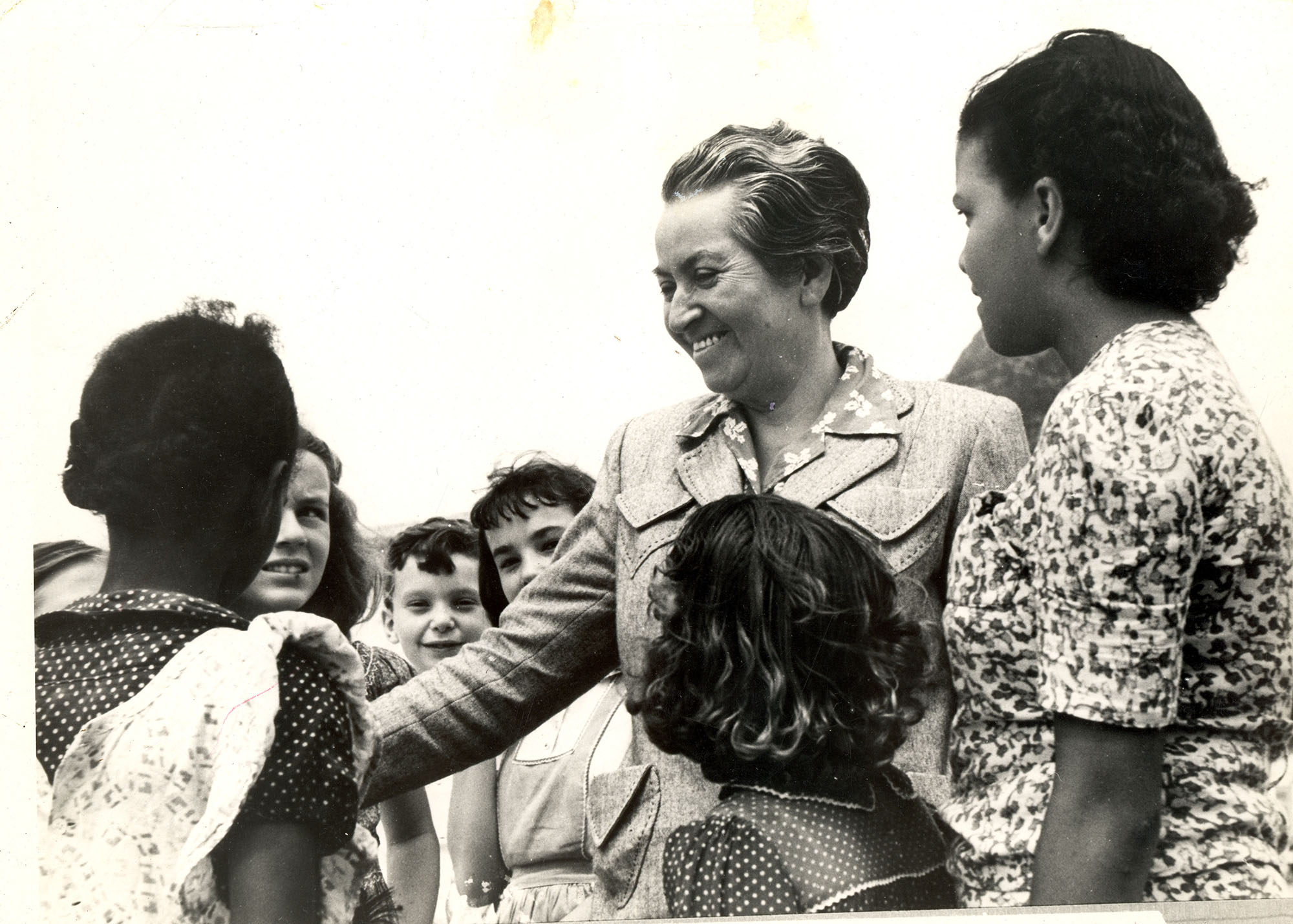
Image: Doris Dana. ·# 19″. Donation from Doris Atkinson in 2007 to the National Library of Chile. Writer’s Archive. Gabriela Mistral Collection; ES0000187. Memoria Chilene